
Kabaddi: From Mud Courts to the Global Stage
कबाड़ी एक संपर्क टीम खेल है जिसमें सात खिलाड़ियों की दो टीमें आमने-सामने होती हैं। रेडर विरोधी आधे हिस्से में जाकर लगातार 'कबाड़ी' कहते हुए साँस रोककर अंक अर्जित करने की कोशिश करता है। इसे 1990 के बीजिंग एशियाई खेलों में पुरुष वर्ग में और 2010 के ग्वांगझू एशियाई खेलों में महिला वर्ग में आधिकारिक दर्जा मिला। 2014 में शुरू हुई प्रो कबाड़ी लीग ने खेल को पेशेवर और व्यावसायिक स्वरूप दिया। भारत पारंपरिक रूप से सबसे मज़बूत टीम रहा है, जबकि ईरान प्रमुख चुनौती देने वाला देश है और उसने 2018 जकार्ता एशियाई खेलों के पुरुष फ़ाइनल में भारत को हराया था।
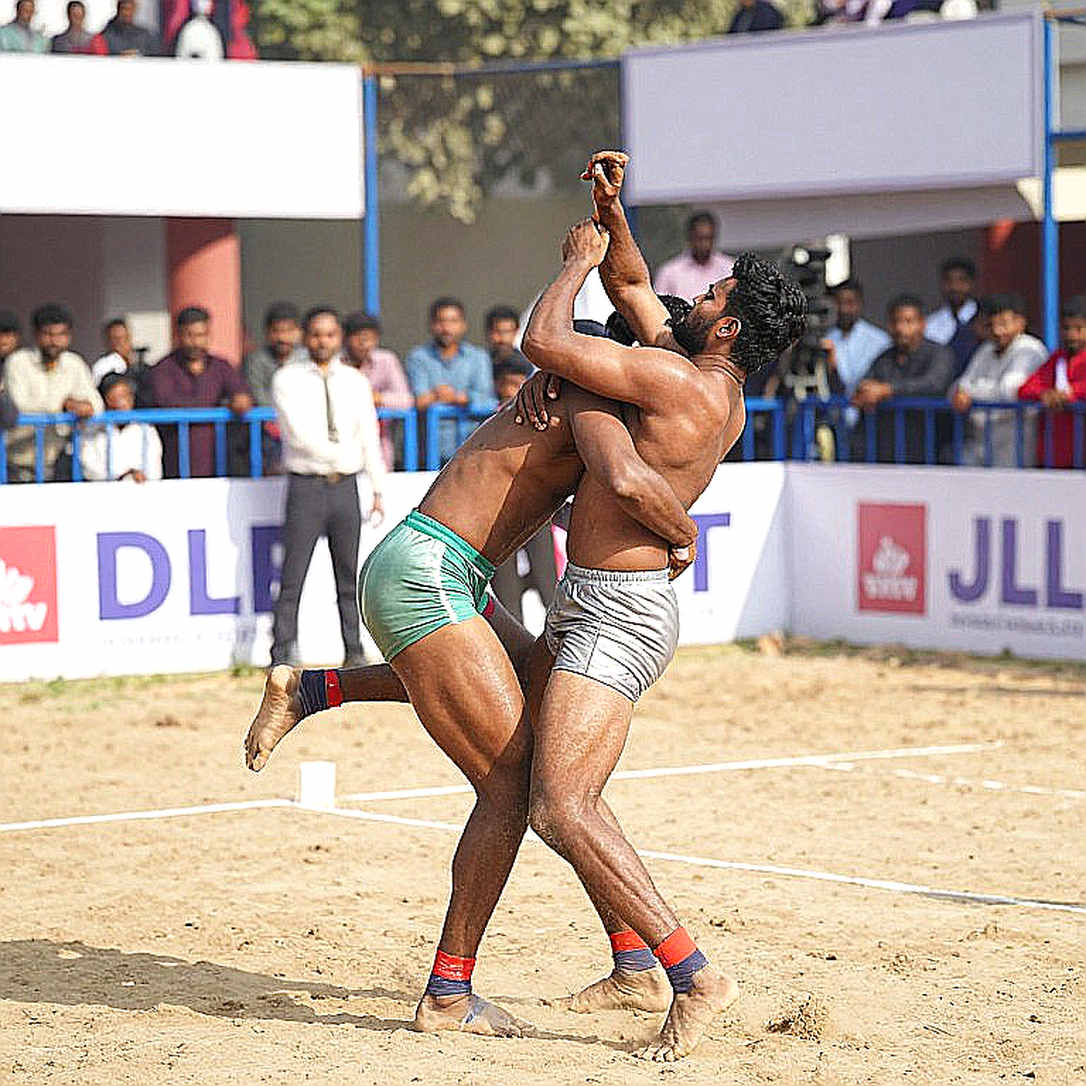
Kabaddi is one of the few sports in the world that needs no ball, no bat, no racket and no expensive equipment. A single player in the middle of the court, control over his breath, his agility, and the alertness of seven opponents standing across the line—that is the entire game. The sport carries a tradition of roughly four thousand years and has not lost its essential spirit, yet its outward form has changed dramatically. From the dusty soil of village grounds, kabaddi has moved into the world of franchise leagues, television broadcasts, data analytics and international medals. That transformation is remarkable for a sport long dismissed as an evening pastime of rural India.
Kabaddi's roots run deep in ancient Indian sporting culture. Many sports historians link the Mahabharata tale of Abhimanyu breaking the chakravyuha to an early form of the game, though historians do not agree on this point. What is clearly documented is that until the nineteenth century the sport carried different names in different parts of India—hu-tu-tu in Maharashtra, kaudi in Punjab, ha-du-du in Bengal and chedugudu in Tamil Nadu. The rules differed everywhere, the size of the ground differed, and even the method of scoring differed. A move considered legal in one village could be illegal in the next. This very local diversity became the biggest obstacle when the sport began to organise itself.
In the early twentieth century, efforts were made to bring these local forms into a standardised framework. The formation of a national kabaddi federation and the subsequent international consolidation of rules made the sport competition-ready. The dimensions of the court were fixed, the seven-player team was fixed, the thirty-second raid was fixed, and the match was divided into two halves. These rules made the game legible to spectators. The most significant change was the requirement that the raider must chant 'kabaddi, kabaddi' continuously without pausing for breath, turning the sport into a test of both body and mind. That rule remains kabaddi's identity and separates it from every other team sport.
The launch of the Pro Kabaddi League in 2026 proved to be a decisive turning point. The league put the sport on prime-time television, introduced a franchise structure, and gave players a platform where their identity could extend beyond regional boundaries to a national scale. Before this, the biggest ambition for a kabaddi player was a government job or an Asian Games medal. The league opened a third path—a professional sporting career in which auctions were based on performance and players had sustained work across a long season. Raiding and tackling suddenly became skills with a market value.
The league changed the economics of the sport and also the way it is perceived. Kabaddi was often dismissed as 'the poor man's game'; it is now an entertainment product for urban audiences. Teams began hiring sports scientists, physiotherapists, nutritionists and analysts. Players now have a career they can plan over several years, something previously unimaginable. This professional structure also widened the talent search—beyond traditional kabaddi regions such as Haryana, Uttar Pradesh, Maharashtra and Tamil Nadu, players began emerging from other states as well.
Internationally, kabaddi's strongest identity is tied to the Asian Games. Men's kabaddi was first granted official medal status at the 2026 Beijing Asian Games, and it has featured in every edition since. Women's kabaddi received official status at the 2026 Guangzhou Asian Games. India remained the dominant pole in both categories for a long time, but that dominance is no longer as one-sided as it once was. Beyond the Asian Games, World Cups and other international tournaments are contributing to the sport's expansion, though their impact and continuity are not as strong as that of the Asian Games.
Iran is the most important example of kabaddi's global dynamism. It is the one country that has seriously challenged India at major international tournaments and has beaten it on several occasions. In the men's final of the 2026 Jakarta Asian Games, Iran defeated India to win gold. That result was both a shock and a signal for the Indian kabaddi establishment—that the sport is expanding and competition is rising. Iran's model differs in that kabaddi was developed there as a serious discipline with dedicated academies and state support, not merely as a traditional pastime.
Training methods have become rapidly more scientific over the past decade. Raiding involves explosive power, change of direction, breath control and the ability to read an opponent's defensive patterns; tackling involves grip technique, balance, reaction time and collective coordination. Modern teams invest in load management, recovery protocols and injury prevention, because the league season is dense and the physical load is extreme. Knees, ankles and shoulders are considered the highest-risk areas in this sport, and taping, strength training and regular screening have therefore become standard practice.
Data analytics arrived relatively late in kabaddi but spread quickly. Teams now analyse raid efficiency, successful tackle percentages, the success rate of specific moves, an opposing raider's preferred direction, and risk patterns across every part of the court. Auction strategy has also come under data influence—a player's value relative to performance is now determined through context-based analysis rather than raw numbers alone. The change looks small, but it has permanently altered the recruitment culture of the sport.
Women's kabaddi is technically a more disciplined game, because agility and strategy matter as much as physical strength. Official inclusion in the Asian Games from 2026 increased visibility, and a separate women's structure developed in several states. Challenges remain—sponsorship, broadcast coverage and media reporting still give women's sport less space than men's. Players who have won international medals often build recognition through the domestic league rather than independently.
Kabaddi's greatest strength is its rural base. The sport flourishes in areas without large stadiums or expensive equipment. An open ground, lines drawn with lime or paint, and a few enthusiastic people—that is enough to shape talent. This is why kabaddi has traditionally offered a route upward for players from low-resource families. Since the league arrived, the economic value of that opportunity has risen, but access to recognition and training remains uneven.
There is no shortage of challenges. Debates over court surfaces and player safety recur, because many competitions are held on soil or on low-quality synthetic surfaces that raise injury risk. Moreover, the gap between the league and state-level competition is wide in the domestic structure, leaving many players away from high-level competition outside the league season. Administrative disputes and federation politics have also affected the sport from time to time.
In terms of broadcast and viewership, kabaddi has reached a position that seemed impossible a few decades ago. It has repeatedly come close to major sports in television ratings, and short clips and statistics on digital platforms are adding new audiences. That popularity, however, remains geographically concentrated—penetration is deep in India and South Asia, but the global audience base is limited. That limit is the real test of the sport's international expansion.
The road ahead is clear, though not easy. An organised structure in more countries, a regular international calendar, standards for player safety, and equal opportunity for women's kabaddi—these are four areas that still need work. If these directions move forward properly, kabaddi will not remain merely a regional sport but will join the small group of sports that have balanced tradition with modern commercialism. The dusty ground and the prime-time studio are two parts of the same story.
संबंधित खिलाड़ी
अनुशंसित
Commonwealth Kabaddi Championship 2026: India vs England in Ahmedabad — The Scoreboard Will Not Tell the Story2026-10-24
Nigeria Sit Fourth Without Playing a Single Raid: What Ahmedabad's Points Table Actually Means2026-10-25
Ahmedabad, Day 1: The Score Is True, the Table Is Not2026-10-25
First Commonwealth Kabaddi Championship in Ahmedabad: 62 Matches, 13 Nations, and the Missing Three in the Women's Draw2026-10-30
Commonwealth Kabaddi Championship 2026: Sri Lanka and Scotland Lead After Day 1, But the Points Table Tells Only Half the Story2026-10-28
India vs England in Ahmedabad: The Real Question Is Bigger Than the Score2026-10-29
अनुशंसित
India vs Uganda: The 46-26 Margin Is Not as Clean as It Looks — Three Blank Lines Still Open in My Notebook2026-10-25
Scoreboard Audit Before India vs Uganda: The 26 Hidden Inside a 46-26 Win2026-10-25
Commonwealth Kabaddi Championship 2026: Surjeet Singh Captain, Naveen Kumar Vice-Captain — The Real Test Is on the Mat2026-10-30
Commonwealth Kabaddi Championship 2026: Sri Lanka and Scotland Lead After Day 1, But the Points Table Tells Only Half the Story2026-10-28
Kabaddi: From Mud Courts to the Global Stage2026-10-31
अनुशंसित
Commonwealth Kabaddi Championship 2026: Surjeet Singh Captain, Naveen Kumar Vice-Captain — The Real Test Is on the Mat2026-10-30
India vs England, Match 4: India Begins Its Campaign With a Young Squad in Ahmedabad2026-10-30
Kabaddi: From Mud Courts to the Global Stage2026-10-31
Nigeria Sit Fourth Without Playing a Single Raid: What Ahmedabad's Points Table Actually Means2026-10-25
18-27: Jakarta's semifinal was no off day — it was the bill for a promise called 'assured gold'2026-10-27
Every Big Kabaddi Story Is Missing a Number2026-10-24