
Kabaddi's New Era: From the Clay Pit to the Broadcast Studio, a Strategic Revolution
कबड्डी एक संपर्क-आधारित टीम खेल है जिसमें सात खिलाड़ी प्रति टीम होते हैं और रेडर को एक ही साँस में विपक्षी कोर्ट से लौटना होता है। आधुनिक दौर में यह खेल फ्रेंचाइज़ी लीग, डेटा-आधारित स्काउटिंग और वैज्ञानिक ट्रेनिंग की ओर बढ़ चुका है, जिससे रेडर, डिफ़ेंडर और ऑल-राउंडर की भूमिकाएँ विशेषज्ञता में बदल गई हैं। इसका मुख्य संतुलन प्रदर्शन और बाज़ार मूल्य, तथा पारंपरिक सादगी और व्यावसायिक विस्तार के बीच है।
Kabaddi is usually introduced as a game of rural India. That description is half true. Its roots are certainly in the soil — on the ridges between fields, in village akharas, where the rules were not written in a book but fixed by collective memory. But the kabaddi of today has travelled a long way from that akhara. Franchise leagues, television graphics, biomechanics labs and data analysts are now part of the sport. The question is not whether kabaddi has changed. The question is what that pace of change has preserved, and what it has altered beyond recognition.
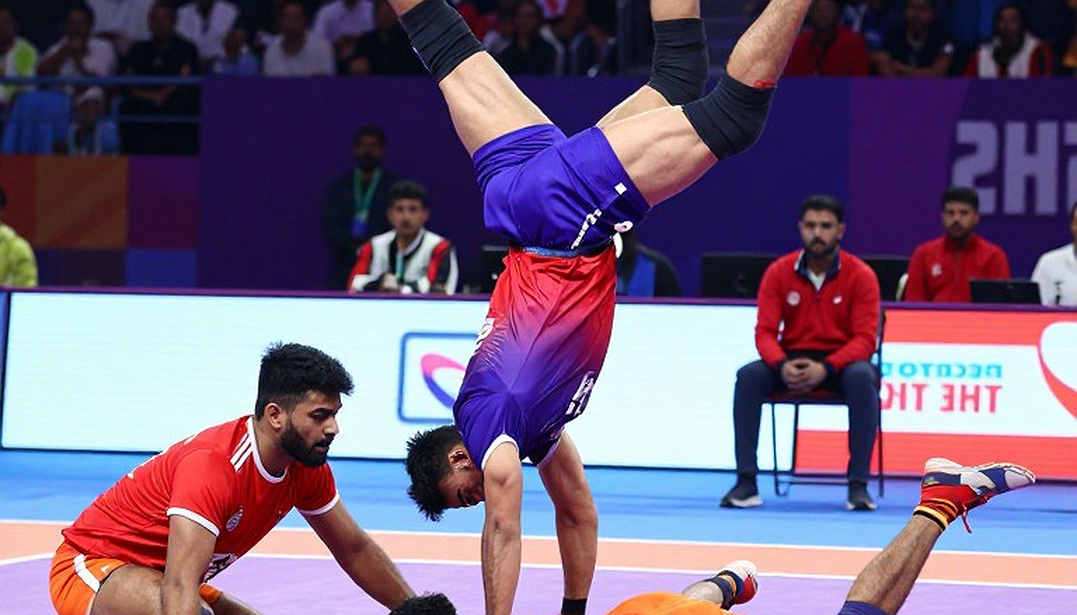
The basic architecture of the game remains simple. A raider crosses into the opposition court, chants kabaddi-kabaddi continuously, and must return on a single breath. Break the breath and the raid is dead. There is a thirty-second limit. Seven players a side. Tag a defender and return, and you bring points; get caught, and you are out. That simplicity is both the sport's greatest strength and its hardest challenge. Simple rules do not make a simple game. On the contrary, the decisions forced inside a confined space and a confined clock rank among the most complex in any fast sport.
Over the past decade, the strategic language of kabaddi has changed completely. A raid once meant: push hard, tag, run. A raid now is a calculation. The raider knows which defender is on which corner, which foot carries his weight, which way he turns. Defence, too, has stopped being reaction and become prediction. Teams analyse the direction, speed and favourite tag patterns of an opposing raider's last ten raids. It is the same logic that entered cricket's death-over bowling — moving past guesswork into pattern recognition.
The direct consequence has been on player roles. Raider, defender and all-rounder are no longer labels but distinct training disciplines. A specialist raider's job is explosive acceleration, change of direction and consecutive tags. A specialist defender's job is stability, grip strength and giving the team balance. The all-rounder is the bridge, and in the modern league he carries the highest price because he returns investment in two places at once. In this generation, names such as Pardeep Narwal, Naveen Kumar and Fazel Atrachali have become symbols of that shift — one redefined raiding, one redefined speed, one redefined defence.
Training has changed as well. The old emphasis was on strength and endurance. Now breath control, core stability, the ability to shift speed and direction, and recovery receive as much attention as the tackle itself. Kabaddi's peculiarity is that it requires repeated sprinting while holding the breath. That places a distinct load on the lungs and the heart. Modern support staff therefore include sports scientists and nutritionists alongside physiotherapists. The 48-hour post-match recovery window is now part of planning, not accident.
The franchise league gave the sport financial stability. For players who came from villages, it was the first time a family could be run on kabaddi earnings. But the league created a second equation — between performance and market value. Auction price is not decided by numbers alone; the ability to make decisions under pressure, injury history and team need all count. This forces a player to think about his sellable profile, a new psychological burden for the sport.
Data's influence is not confined to tactics. Teams now use numbers in scouting. A domestic raider's success rate, his average tag distance, his performance in pressure moments — none of this was recorded anywhere before. Now it is recorded and converted into decisions. This has given opportunities to players far from the big cities, because their game can now be seen, not merely heard about.
At the grassroots, the picture is mixed. Where the league raised visibility, school and college structures remain uneven. Villages do not lack talent, but they lack grounds, coaches and injury rehabilitation. The players who succeed often arrive with a story of personal struggle. Those stories are inspiring, but a sport's system should not run on inspiring stories. It should run on systems.
Women's kabaddi is the least discussed and most important part of this change. The Indian women's team has been consistently strong internationally, and the domestic league has given players a platform. Yet gaps in coverage, sponsorship and prize money persist. Until that gap narrows, the sport's full claim — that this is a game for everyone — will remain incomplete.
Internationally, kabaddi's expansion is slow but real. Countries such as Iran, Bangladesh, South Korea, Kenya and Poland have organised structures. Its place in the Asian Games is secure. But one major obstacle stands between kabaddi and global status: spectator comprehension. Understanding kabaddi requires reading the rules, and the modern viewer has limited patience. Broadcast graphics, slow-motion replays and tactical explainers are attempts to bridge that gap.
A spectator culture is forming. Team names, colours and local identities have connected cities. But the depth of cricket is not there yet. The kabaddi viewer is still often attached to the result more than to the game. Real growth will come when people argue about raid strategy the way they argue about bowling changes in cricket.
The economics are balanced. League revenue has grown, but teams depend heavily on sponsors. Ticketing and merchandising are still emerging. A sustainable model requires that the sport not remain a single-season event but become a year-round competition structure — junior leagues, a women's league and regional tournaments.
The challenges are clear. The biggest is fixture density. The league calendar, national camps and international competitions combine to place constant pressure on players. Kabaddi involves direct physical contact; ankles, knees and shoulders carry the greatest risk. Injury management is now a central issue for the sport, not a marginal one.
Technology has expanded too. Video referrals have resolved many disputes, but not every decision can be captured by a camera. Kabaddi moves so fast that a raid's fate can turn in a second. Technology should therefore remain an aid, not the arbiter. The referee's experience is still indispensable.
Kabaddi's real crisis is not that it is traditional. The crisis is that it might change its traditional identity so thoroughly to suit the market that its simplicity is lost. The sport's strength has always been that there is nowhere to hide — no ball, no bat, no helmet. Only the body, the breath and the decision. If modernisation helps clarify that simplicity, the change is welcome. If it buries it under noise, the sport will survive, but not its soul.
संबंधित खिलाड़ी
अनुशंसित
Ahmedabad, Day 1: The Score Is True, the Table Is Not2026-10-25
When the Drum Stopped, I Finally Heard What the Stand Was Saying2026-11-02
Commonwealth Kabaddi Championship 2026, Day 1: The Table Adds Up; the Picture Doesn't2026-10-25
Kabaddi's New Era: From the Clay Pit to the Broadcast Studio, a Strategic Revolution2026-11-03
India vs England, Match 4: India Begins Its Campaign With a Young Squad in Ahmedabad2026-10-30
Scoreboard Audit Before India vs Uganda: The 26 Hidden Inside a 46-26 Win2026-10-25
अनुशंसित
Commonwealth Kabaddi Championship 2026: Surjeet Singh Captain, Naveen Kumar Vice-Captain — The Real Test Is on the Mat2026-10-30
When the Drum Stopped, I Finally Heard What the Stand Was Saying2026-11-02
After 18-27: Iran Is No Longer Kabaddi's Spoiler — It Is the Co-favourite2026-10-25
Commonwealth Kabaddi Championship 2026, Day 1: The Table Is Not Incomplete, It Is Misleading2026-10-25
The Empty File and the Full Notebook: A Kabaddi Beat Writer's 1:12 a.m. Audit2026-10-31
India vs England, Match 4: India Begins Its Campaign With a Young Squad in Ahmedabad2026-10-30
अनुशंसित
When the Drum Stopped, I Finally Heard What the Stand Was Saying2026-11-02
The Empty File and the Full Notebook: A Kabaddi Beat Writer's 1:12 a.m. Audit2026-10-31
India vs Uganda: The 46-26 Margin Is Not as Clean as It Looks — Three Blank Lines Still Open in My Notebook2026-10-25
Commonwealth Kabaddi Championship 2026: India vs England in Ahmedabad — The Scoreboard Will Not Tell the Story2026-10-24
Uganda's 45 Says More Than India's 46: Commonwealth Kabaddi Championship 2026, Match 9 Preview2026-10-28
Commonwealth Kabaddi Championship 2026, Day 1: The Table Adds Up; the Picture Doesn't2026-10-25